Leaving Cert Music
  • Welcome
    • 5th yr xmas '15
    • 5th Year Xmas test '12
  • Composition
    • Basic sight singing
    • Harmony homework
    • Melody Homework
    • Tonic Solfa and basic rhythm >
      • 4-bar pentatonic
      • 16-bar Rhythmic plan
    • 8-Bar melodies >
      • In G
      • In D
      • In A
      • In E
      • In F
      • In Bb
      • In Eb
      • In Ab
    • Form/Cadence
    • Modulation/Sequence
    • Minor - Theory and listening >
      • Minor Harmony Q.5 2012
      • Minor Tonic Solfa
    • Sample melodies >
      • 2012
      • 2008 and 2010
      • 2007 and 2009
      • Q.3 2006 and 2010
    • Rules - guidelines >
      • Scales and chords
    • Harmony Basics >
      • Harmony 2005
      • Harmony Loose ends
  • Bohemian Rhapsody
    • Form and Audio
    • Instruments
  • Romeo and Juliet
    • Themes
    • Video
    • Structure
    • Glossary of Terms and other features
    • Work sheets
    • Exam questions
  • Bach Cantata
    • 1st Movement - Chorus
    • 2nd Movement - Aria Duet
    • 3rd Movement Tenor Recitative
    • 4th Movement Tenor Aria
    • 5th Movement Bass Recitative
    • 6th Movement Bass Aria
    • 7th Movement - Chorale
    • Tonality and Form
    • Hymn
    • Important Terms
    • Comparisons
    • Test
  • Piano Quartet
    • Section by Section
    • How to remember all the sections
    • Use of Canon
    • Themes
    • Glossary of terms
    • Time Signatures
    • Exam questions
  • Traditional Irish Music
    • Listening to Traditional Irish Music >
      • listening practice
      • Trad past paper listening excerpts
    • Traditional Irish Dance Music
    • Céilí bands
    • The Irish Harp
    • Traditional Instruments >
      • Uilleann Pipes
    • Sean Nós Singing
    • The song tradition
    • Regional Styles
    • Ornamentation
    • Seán O'Riada
    • Changes/ Developments
    • Fusion
    • Michael McGlynn, Dúlamán, (fusion)
    • American folk
    • Collectors
    • Danu
    • Muireann nic Amhlaoibh
    • Organisations
    • The exam
  • Listening
    • Style
    • Listening homework
    • Texture
    • Timbre
    • Tonality
    • Form
    • Tempo, Dynamics, Articulation, Pitch
    • Q.6 Unprepared listening excerpts
    • Un-prepared "Analysis" >
      • Halleluia Chorus
      • Muse - Exogenesis symphony pt.3
      • Stravinsky L.C. '0
      • Dambusters
      • Inception - Hans Zimmer
      • timedance and iris
    • Great Music >
      • Beethoven
      • Stravinsky's Rite of Spring
      • French Impressionism
  • The Beatles
    • Sgt. Pepper album
    • George Martin's recording notes
    • Sgt. Pepper song
    • She's Leaving Home
    • When I'm 64
  • Seachanges
    • Homework
    • Introduction
    • Section 1
    • Section 2
    • Section 3
    • Section 4
    • Section 5
    • Section 6
  • Berlioz
    • Ideé Fixé
    • 2nd movement "A Ball"
    • 4th Movement "March to the scaffold"
  • Mozart
    • Themes
    • 1st Movement - Sonata Form
    • 2nd Movement - Ternary form (ABA)
    • 3rd Movement Sonata Rondo form
    • Score and Tonality
    • The piano
    • Documentary - The genius of Mozart
    • Key Listening practice
  • Course Content

 Dies Irae (Day of Wrath) 

Dies Irae is a 13th Century poem which describes the day of judgment, the last trumpet summoning souls before the throne of God, where the saved will be delivered and the unsaved cast into eternal flames. The hymn Dies Irae is best known from its use as a sequence in the Roman Catholic Requiem mass (Mass for the Dead or Funeral Mass). Below is a recording of how it would have sounded in the 13th Century, chanted by monks.
Look up various Dies iraes on youtube to get the idea of how the interpretation changed over the centuries. (Saint-Sains, Verdi, Mozart, Fauré, Karl Jenkins). This is Raymond Deane's versiono DiesIrae.
Section 4
Picture
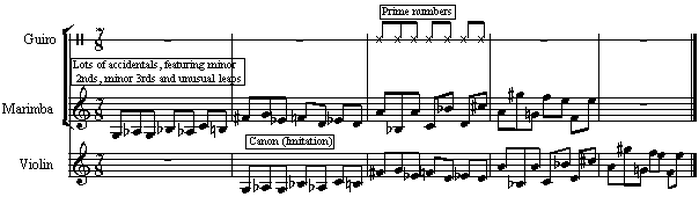
This section is characterised by unusual intervals, (e.g. minor 2nds), dissonance (clashy chords), a canon between marimba and violin and use of prime numbers on guiro.

Powered by Create your own unique website with customizable templates.